
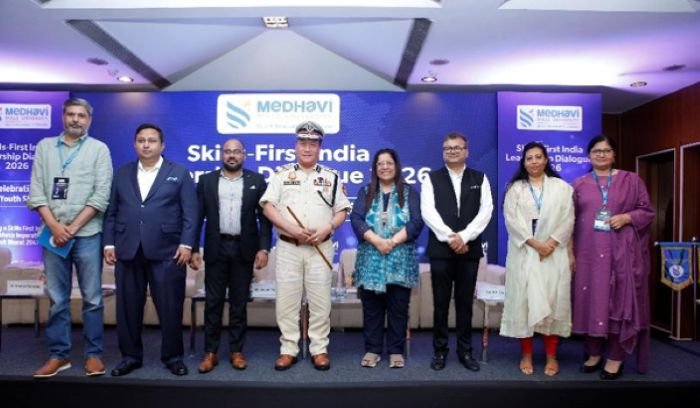
Bringing together leaders from industry, government and academia, Medhavi Skills University (MSU) convened its inaugural Leadership Dialogue in New Delhi on July 14 on the theme, “Building a Skills-First India: The Workforce Imperative for Viksit Bharat 2047.” Held on the eve of World Youth Skills Day, the event featured two panel discussions that sought to place the global conversation on skills within India’s rapidly evolving economic landscape. Speakers underlined that a truly shared future can only be realised through a skills-first ecosystem where education, industry and government work in close partnership.
The event featured keynote addresses by Robin Hibu, IPS, Special Commissioner (HR) and Director General of Police (DGP), Delhi Police, and Nikhil Kanodia, Managing Director, Precision Electronics.
In his keynote address, Hibu, a decorated police officer who also runs the NGO Helping Hands to support people from Northeast India in distress, argued for a fundamental rethinking of India’s skilling ecosystem. Highlighting gaps between skill development centres and local employment needs, he pointed to the absence of baseline surveys, poorly equipped training centres, observations made in CAG and PAC reports, and the lack of post-training support for migrant workers. “There should be a dedicated cadre of skill trainers so that qualified training staff are readily available wherever required,” he said.
Kanodia said the biggest challenge facing Indian industry continues to be the shortage of appropriately skilled workers. “India’s greatest natural resource is its youth population, and the choices we make today for them will shape our future. Work-integrated apprenticeships, industry-led curriculum development and measuring student productivity can help bring all stakeholders together,” he said.
Earlier, inaugurating the dialogue, Pravesh Dudani, Founder and Chancellor of Medhavi Skills University, said, “This year’s World Youth Skills Day theme, ‘Skills for a Shared Future’, is a timely reminder that the future cannot be built in silos. India has an unprecedented opportunity to lead by creating a skills-first ecosystem where education, industry and government work together to transform learning into livelihood and potential into productivity.”
Kuldip Sarma, Co-Founder and Pro-Chancellor of the university, added, “Building a Skills-First India is a shared national responsibility on our journey towards Viksit Bharat. This Leadership Dialogue is our effort to bring together the voices that matter and foster sustained conversations around the partnerships, policies and pathways needed to equip young Indians for the future of work.”
The panel discussions explored how industry can play a more active role in nurturing talent by partnering with higher education institutions and integrating work-based learning into mainstream education. Participants included Atanu Banerjee, CEO, Spectrum Talent Management Ltd.; Vivek Sinha, Founder and CEO, Emversity; Neeraj Malik, Whole-Time Director, Board Member and Chief Business Officer, Aptech Pvt. Ltd.; Asha Pathania, Senior Vice President – FM & Hospitality, PVR INOX; Ashissh Kapoor, Director – Human Resources, Ernst & Young; Dr Anjlee Prakash, Founder, Learning Links Foundation; Suchita Dutta, Executive Director, Indian Staffing Federation; Debmalya Banerjee, Regional Director (Northern Region), Indian Chamber of Commerce; Jassi Dimple, Vice President and Dean (Academics), Medhavi Skills University; Ankush Arora, HR Transformation Leader; and Dr Swati Popat Vats, President, Early Childhood Association India, and President, Podar Education Network.
With the launch of its flagship Leadership Dialogue, Medhavi Skills University signalled its intent to create an enduring platform for national conversations on skills and workforce development. The initiative reinforces the belief that India’s journey towards Viksit Bharat 2047 will be determined not only by the size of its workforce but by the quality of its skills ecosystem and a collective commitment to creating “skills for a shared future.”