
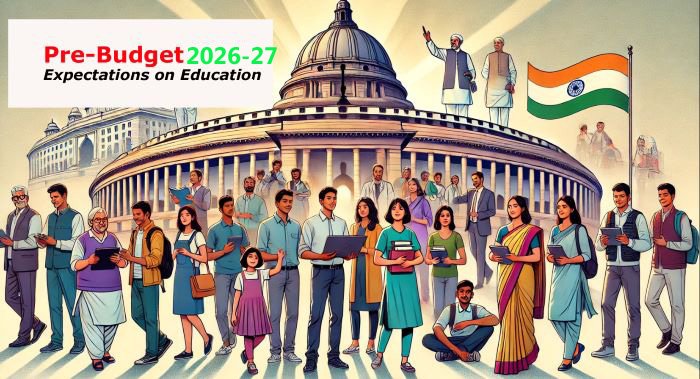
Last year’s Union Budget sent a clear signal that education is central to India’s growth story. With a landmark allocation of ₹1.28 trillion and the launch of initiatives such as the Centre of Excellence in AI for Education with a ₹500 crore outlay, the government positioned technology, innovation, and future-ready skills at the heart of learning reform. All eyes are now on the upcoming budget to see how it builds on these gains and aligns with the evolving priorities and expectations across India’s education and skilling ecosystems.
(the expectations appear in this article appear in order of higher ed, skilling, tech and school ed)
Higher Education
As India repositions its higher education system under NEP 2020, the sector is increasingly being viewed not merely as a social responsibility, but as a strategic economic investment.
While the previous budget strengthened foundational pillars through digital platforms, research missions, and skill initiatives, higher education leaders now believe the next leap must transform universities into globally competitive knowledge hubs—driving research, innovation, employability, and international collaboration. From funding reform and industry partnerships to AI-led learning and global mobility, stakeholders say Budget 2026 must treat higher education as national capability-building. The consensus is clear: the coming budget must mark a shift from access to excellence, from capacity to outcomes, and from spending to strategic investment. By funding research, embracing AI, deepening industry ties, and opening doors to global collaboration, India can turn its universities into engines of innovation and global influence—powering the nation’s journey to a knowledge-driven economy.
A central theme running through industry voices is the need to reimagine how higher education is financed. Vishal Anand, Founder and Pro Chancellor of Shoolini University, calls for a structural overhaul, urging that education and research capital expenditure be classified under priority lending with 25-year long-term financing for universities as national assets. He also proposes that research and intellectual property be included under CSR funding, that for-profit education models be permitted to attract global capital, and that collateral-free education loans be introduced to raise India’s higher education enrolment, which still remains below 30 per cent.
Echoing this focus on research, Dr. Yajulu Medury, Vice Chancellor of Mahindra University, believes Budget 2026 should firmly establish universities as centres of advanced research and innovation. He anticipates higher allocations that will strengthen synergy between industry and academia and position Indian institutions as engines of discovery and development.
However, leaders caution that this transformation must be inclusive. Prof. P. S. Sastry, Dean at Vidyashilp University, highlights the risk of smaller and regional institutions being left behind. He notes that even modest funding for small research projects and basic lab infrastructure can make a decisive difference, and urges the government to ensure regulatory reform widens, rather than narrows, India’s academic and research ecosystem.
From an employability lens, Vinay Maheshwari, Executive Director at Mohan Babu University, stresses the need for AI-led research, upgraded infrastructure, tax relief on research equipment, wider CSR participation, inclusive access to the ANRF, and expanded scholarships—especially for underserved regions. His emphasis mirrors a broader industry concern that higher education must translate more directly into workforce readiness.
Dr. Debashis Sanyal, Director at Great Lakes Institute of Management, takes this idea further by calling for education to be recognised as economic infrastructure. He believes the budget must shift focus toward preparing students for evolving jobs through flexible curricula, industry-linked programmes, and regional skill ecosystems, while ensuring that quality education expands beyond metros without widening inequality.
Discipline-specific institutions also see Budget 2026 as a moment for transformation. Prof. Anand Achari, Principal of VES College of Architecture, says architecture and design education must evolve alongside India’s rapidly changing urban and environmental landscape. He advocates for the integration of AI, data analytics, BIM, and sustainability design into mainstream curricula, supported by funding for digital tools, live projects, internships, and industry partnerships.
Technology, many argue, must sit at the core of reform. Prof. Subir Verma, Director of FORE School of Management, asserts that AI must move from the margins to the centre of education policy—not merely as a technical subject, but as a managerial, ethical, and decision-making tool. He calls for investments in AI research, simulation-based learning, data infrastructure, and responsible AI frameworks to drive employability and innovation.
For Dr. Tapash Kumar Ganguli, Director-General of NICMAR, bridging the academia–industry gap will depend on targeted funding for advanced labs, sustainability research, applied R&D, and public–private collaboration. Similarly, Dr. Sanjay Gupta, Vice Chancellor of World University of Design, believes that India’s next growth phase will be powered by design, creativity, and digital transformation. Dedicated funding for design-led R&D, creative-technology labs, and industry-linked universities, he says, can help India move from cost competitiveness to innovation leadership.
India’s global aspirations also feature strongly in leaders’ expectations. Dr. Anita Patankar of Symbiosis Dubai calls for interdisciplinary learning, digital infrastructure, international collaboration, and affordability. Tripti Maheshwari of Student Circus urges outcome-linked funding tied to employability and global industry exposure, while Omar Chihane of ETS advocates merit-based scholarships, joint research pathways, and international exchange programmes to position India as a global education hub.
Across the spectrum, from Aritra Ghosal of OneStep Global to Praveen K. Pula of Woxsen University and Abhay G. Chebbi of Alliance University, a common message emerges: expansion alone is not enough. Growth must be matched by quality, skills, and industry relevance, including the creation of Distinguished Skill Universities.
— a shared vision for Budget 2026—t treats higher education not as an expense, but as a long-term investment in India’s economic, technological, and global future.
Skilling
As India positions itself as a global talent powerhouse, the conversation around skilling is rapidly evolving—from counting training numbers to building job-ready, future-proof capabilities. With one of the world’s youngest populations and a fast-changing digital economy, Budget 2026 is widely expected to play a defining role in shaping the country’s workforce. Industry and education leaders agree that the next phase of reform must connect learning to livelihoods, strengthen digital access, and embed real-world exposure across education and employment pathways.
For Jeel Gandhi, CEO of Under25, structured and paid internships must become a national bridge to jobs. She believes that industry–academia collaboration can significantly ease young Indians’ transition from education to employment, unlocking the country’s demographic dividend. She also emphasizes the need for affordable internet and digital infrastructure in Tier 2 and Tier 3 cities, along with a sharper focus on Gen Z–ready skills across digital, creative, communication, AI, and other new-age technologies.
Ajit Chauhan, Chairman of Amity University Online, sees online education as the cornerstone of access in a nation where nearly two-thirds of the population is under 35. He argues that skilling must be deeply integrated with AI and digital platforms, supported by targeted incentives for large-scale AI skilling, curriculum redesign, faculty training, and advanced learning systems. Strengthening online education as a mainstream pathway, he says, is essential for widening access and building skilled human capital.
For Kuldip Sarma, Pro-Chancellor and Co-Founder, skilling reform must move closer to the real economy. He urges renewed fiscal support for apprenticeships, research and development, flexible learning pathways, recognition of prior learning, and inclusive access to AI for underrepresented communities. This, he adds, must be backed by grassroots teacher training and improved digital reach to ensure equitable access to opportunity.
Sustainability also features prominently in the skilling discourse. Ayushi Mishra, Climate Finance Expert at MSC, believes that higher allocations for Livelihood Missions can integrate self-help groups into green value chains, from solar infrastructure maintenance to circular waste management. She also calls for climate-resilient agriculture supported by de-risked financial and technical products, arguing that aligning livelihoods with India’s climate commitments will build both economic and environmental resilience at the grassroots.
From a workforce infrastructure perspective, Sonali Chowdhry, CEO of Officenet, highlights the importance of National Centres of Excellence in Skilling to enhance employability and productivity. She also points to growing support for gig workers and the role of digital HR platforms in bridging skill gaps and optimizing workforce management across industries.
For Dr. Sanjay Salunkhe, Founder of Jaro Education, digital education is key to scaling future-ready talent, particularly among working professionals across regions. He stresses that globally competitive curricula, research-led learning, and deeper university–industry collaboration are critical to developing a workforce equipped for tomorrow’s challenges.
Finally, Pushkar Saran, Executive Director at TOEIC, ETS, warns that India must move beyond training volumes to focus on standardized, job-relevant validation of workplace skills aligned with global employer expectations. Without addressing this skills validation gap, he cautions, India risks under-leveraging its talent potential at a time when global demand for Indian professionals is rising.
Essentially the message is linking aspiration to opportunity and preparing India’s workforce to compete on the global stage.
Edtech
Education leaders believe the next Union Budget must move beyond pilot projects and position digital and AI-powered learning as national infrastructure. With online education gaining legitimacy, AI Centres of Excellence already funded, and employability gradually rising, the focus now must be on scaling impact, closing the last-mile skills gap, and embedding technology across the education ecosystem. From AI-enabled classrooms to job-linked digital degrees, stakeholders see Budget 2026 as a turning point for making tech-driven learning inclusive, outcome-oriented, and globally competitive.
For Siddharth Banerjee, CEO of Univo Education, the next budget must double down on digital foundations. He believes that targeted investments in digital infrastructure can expand high-quality online education at scale, while deeper academia–industry collaboration will ensure curricula remain job-linked and future-ready. Embedding AI across the education ecosystem, he adds, will be critical to developing globally competitive institutions and talent, while strengthening online degree programmes to help India reach its 50 per cent GER target by 2035 and advance the vision of Viksit Bharat.
Highlighting a persistent disconnect, Dr. Swapnil Sahoo, Assistant Professor at Great Lakes Institute of Management, Gurgaon, notes that while graduate employability has risen to 56.35 per cent, the gap between academia and industry remains stark. With ₹500 crore already committed to AI Centres of Excellence, he urges Budget 2026 to now incentivise “last-mile skilling”, including a tax holiday for EdTech firms that bridge employability gaps—particularly for the rapidly growing gig workforce.
For Deepak Verma, CEO of EnglishHelpe, technology must ultimately be a tool for inclusion. He believes AI-enabled platforms can personalise learning, boosting English proficiency, critical thinking, and digital skills—especially for underserved students. To ensure innovation translates into real impact, he calls for fiscal support, measurable outcomes, and large-scale teacher upskilling.
Crux: Budget 2026 must treat technology not as an add-on, but as the backbone of India’s education future—one that empowers learners, strengthens institutions, and positions the nation as a global knowledge leader.
School Education
While India’s last education budget laid a powerful technological foundation, school education leaders agree that the next leap must be human-centric—focused not just on devices and platforms, but on teachers, learners, mental well-being, career readiness, and measurable outcomes. Large-scale programmes such as Atal Tinkering Labs, now active in over 10,000 schools and engaging more than 1.1 crore students, reflect the ambition to make hands-on STEM and computational learning mainstream. National platforms like YUVA – AI for All are also democratizing foundational AI literacy among students and youth. Alongside these, investments in digital infrastructure, school innovation labs, and teacher training have laid the groundwork for technology-driven classrooms.
Yet, education leaders say the time has come to move beyond infrastructure and focus on outcomes, equity, and holistic development through sharper budgetary emphasis.
For Niyati Handa, Co-founder and Director of Eklavya, the next phase of reform must begin at the roots. She believes a substantive increase in the school education budget is essential, particularly at the foundational level. According to her, investments in teacher training, curriculum modernization, and age-appropriate learning frameworks must take place holistically to build strong academic and cognitive foundations. She also stresses the urgency of bridging the urban–rural divide through funding that scales digital and hybrid learning models across Tier 2, Tier 3, and rural regions. Geography, she says, should never limit potential, adding that continuous teacher upskilling, merit-based scholarships, and closer alignment between education and career outcomes must define the next budget.
For Arti Dawar, CEO of Shiv Nadar School, implementation is as critical as vision. She emphasizes that continued progress will depend on faster execution of NEP 2020, supported by teacher training, institutional capacity building, and outcome-driven reforms. Universal digital infrastructure, deeper industry–academia collaboration, and sustained investment in skills and research, she believes, are vital to strengthening India’s human capital and advancing the goal of Atmanirbhar Bharat.
Atul Temurnikar, Chairman and Co-founder of Global Schools Group, argues that the scale of India’s education system demands a sharper focus on learning impact rather than inputs. With over 250 million students in the system, he says the real challenge is not enrolment, but outcomes—how well children can apply concepts and adapt to a rapidly changing world. He believes the next budget must reward innovation, teacher enablement, and measurable learning outcomes, shifting the system from spending on infrastructure to delivering real impact.
For Shaheen Mistri, Founder and CEO of Teach For India, progress in Foundational Literacy and Numeracy has created space for a more expansive vision. She urges the government to now invest in holistic education for every child. This includes funding for holistic assessments, school leadership capacity, progressive pedagogy, social-emotional learning, mental health, and the thoughtful use of AI and technology. In her words, an investment in education is an investment in the nation’s next generation of leaders.
Looking toward the future of work, Dilip Gangaramani, Founder Director and CEO of Target Learning Ventures, expects the next budget to accelerate the integration of new-age technologies into classrooms. He believes digital infrastructure must be strengthened and courses introduced in AI, robotics, drone technology, 3D printing, app development, and sustainable technologies. These skills, he says, will prepare students not only for jobs, but for innovation and problem-solving in a digital economy.
Finally, Ganesh Kohli, Founder of the IC3 Movement, highlights a critical yet often overlooked aspect of school education: counselling. He believes Budget 2026 offers a timely opportunity to strengthen counselling capacity at the school level, helping students understand their pathways with clarity, confidence, and purpose. A globally credible education system, he says, must guide learners to align their aspirations with real opportunities early in life.
As India aspires to become a knowledge-driven $7-trillion economy, the message from the school education ecosystem is clear: the future of the nation will be shaped in its classrooms—if the next budget chooses depth, equity, and impact over scale alone.