
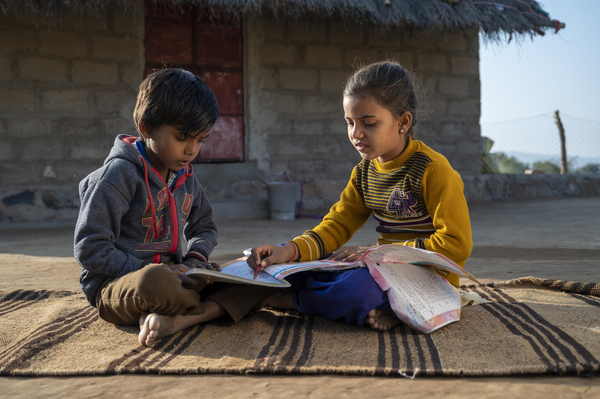
Limited access to devices, low connectivity, and limited teacher contact are severely constraining remote learning in the region
School closures have led to alarming inequities in learning opportunities for children in South Asia, despite significant efforts by governments and partners to expand remote learning, according to UNICEF research conducted in India, the Maldives, Pakistan and Sri Lanka.
School closures in South Asia due to the COVID-19 pandemic have interrupted the learning of 434 million children. According to UNICEF’s research, a substantial proportion of students and their parents reported that students learnt significantly less compared to pre-pandemic levels. In India, 80 per cent of children aged 14-18 years reported lower levels of learning than when physically at school. Similarly, in Sri Lanka, 69 per cent of parents of primary school children reported that their children were learning “less” or “a lot less.” Girls, children from the most disadvantaged households and children with disabilities faced the biggest challenges while learning remotely.
“School closures in South Asia have forced hundreds of millions of children and their teachers to transition to remote learning in a region with low connectivity and device affordability,” said George Laryea-Adjei, UNICEF Regional Director for South Asia. “Even when a family has access to technology, children are not always able to access it. As a result, children have suffered enormous setbacks in their learning journey.”
Despite significant efforts from governments, low connectivity and access to digital devices have severely hampered efforts to roll out remote learning. In India, 42 per cent of children between 6-13 years reported not using any type of remote learning during school closures. In Pakistan 23 per cent of younger children didn’t have access to any device that could support remote learning. Poor and disadvantaged households have been the worst hit, with many families struggling to afford even a single device.
Even when devices are available, UNICEF’s research indicates that they are often underutilized and that children’s access to them is often limited. For example, in Pakistan, among children with access to devices, only about 24 per cent could use them when they wanted to.
The research found that student-teacher engagement, when regular and reciprocal, is a strong predictor of success in children’s learning, especially for younger students. However, the surveys found that most students had little or no contact with their teachers after schools closed. In Sri Lankan private primary schools, 52 per cent of teachers reported contacting their students five days a week, but this number dropped to only 8 per cent for teachers from public primary schools.
The research was conducted by UNICEF using data from household surveys commissioned by UNICEF in India, Pakistan, and Sri Lanka, and by the Ministry of Education in the Maldives. These surveys were conducted between 2020-21 using UNICEF South Asia’s Monitoring Guidance. The aim of the research is to better understand and improve the reach and effectiveness of distance learning during school closures.
In India, Computer Assisted Telephonic Interviewing was used to survey over 5,800 parents of children aged 5-13 years, and students ages 14-18 years, as well as government school teachers, across six states: Assam, Bihar, Gujarat, Kerala, Madhya Pradesh and Uttar Pradesh. To ensure representation of marginalized groups – parents from migrant families, and from tribal and remote locations were included. In the Maldives, online surveys of teachers, students, and parents were conducted. In Pakistan, teachers, parents, and students (ages 14-17 years) were surveyed through Interactive Voice Response calls. In Sri Lanka, face to face interviews was conducted with parents of primary school children (grades 1-4) and focus group discussions with teachers.
Speaking on school reopening, Dr Yasmin Ali Haque, Representative, UNICEF India said, “Going to school is a central part of children’s life. The prolonged school closure due to COVID-19 has caused many children to miss out on learning, social interaction and playtime which are essential to their overall development and well being.Safe and gradual reopening of schools in the states of India is a welcome moveas children learn best in person and this will help prevent further learning loss and alleviate some of the pscychological stress they are facing. The safety element is critical, Teachers, parents, children and communities can work together along with the Government, to put in place the protocols needed for children to return to schools and learn in a safe environment.”
“We need to focus on rapidly building capacities of teachers who can support learning both in the classroom as well as at home more effectively. We have examples from states like Bihar, where several devices are being purchased for students to support learning. Now is the time to plan and put the structures in place to transitionchildren back into learning. We need to build back better and stronger,” she added.
To ensure that children keep learning, UNICEF is calling on:
- Governments to prioritize the safe reopening of all schools, while also ensuring that children are able to pursue quality learning remotely if necessary
- Teachers to assess children’s learning levels and ensure catch up is enabled through a “learning recovery” period
- Governments to prioritize the vaccination of teachers to support the safe reopening of schools
- Governments to train and equip teachers to better reach children and adolescents with limited or no access to technology through a combination of modalitiesincluding mobile devices, TV, radio, and printed materials
- Governments and donors to protect and expand investments in education, including critical pre-primary and foundational literacy and numeracy
- Private sector and civil society organizations to work with governments in improving connectivity and creating high-quality, multilingual remote learning content tailored to students’ needs
- School administrators and education officials to provide more guidance to teachers to engage with their students and use different types of learning techniques
- Parents and caregivers to receive adequate support and guidance to continue home-based learning
“The safe reopening of schools must be considered an utmost priority for all governments. Parallelly, investing in teachers will ensure that teachers and schools can adapt to all situations. The more teachers are trained, equipped and supported on distance and blended learning, the better they will be able to reach all their students,” added George Laryea-Adjei. “This is a critical investment we need to make for children as the region gears up for future waves of COVID-19. We need to build systems which can weather any storm and keep children learning, no matter the circumstances.”
School closures in South Asia have compounded a situation which was already precarious. Even before the pandemic, almost 60 per cent of children in South Asia were unable to read and understand a simple text by the time they are 10 years old. In addition, 12.5 million children at the primary level and 16.5 million children at the lower secondary level were out of school.