
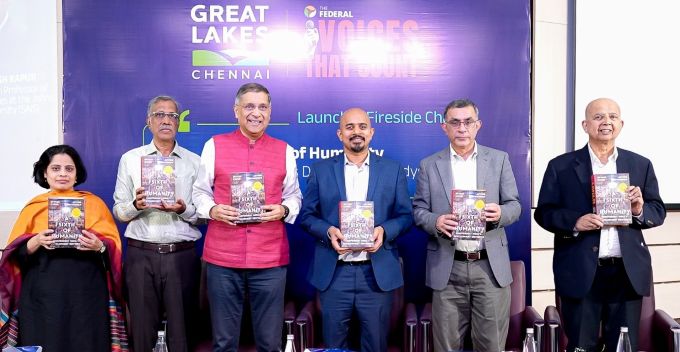
Great Lakes Institute of Management, Chennai on Dec 3 hosted the official launch of A Sixth of Humanity, authored by Prof Arvind Subramanian, Ex-Chief Economic Advisor of India and Senior Fellow at the Peterson Institute for International Economics and Prof Devesh Kapur, Starr Foundation Professor of South, Asian Studies at the Johns Hopkins, University (SAIS) at its campus. The book examines India’s development trajectory through a set of structural themes and long-term trends that shape the country’s political, economic and social landscape.
A Sixth of Humanity traces India’s development through five interconnected themes: how a diverse nation was forged, how democracy advanced ahead of prosperity, how the state has delivered public goods with uneven capacity, how markets have expanded without always achieving structural transformation and how society navigates the pressures of identity and change. Drawing on data, institutional research and historical context, the authors present a long-view analysis of India’s achievements, constraints and future possibilities. The book encourages readers to move beyond surface narratives and engage with the deeper forces that shape India’s trajectory.
The event brought together faculty, students and guests for a series of conversations that explored the book’s central ideas, the evidence underpinning them and their relevance for India’s future. The launch was followed by a detailed fireside discussion featuring the authors alongside Prof Vidya Mahambare, Professor of Economics at Great Lakes Institute of Management.
Welcoming the authors, Dr Debashis Sanyal, Director, Great Lakes Institute of Management, Chennai, said, “A management school cannot confine itself to teaching technical skills. Students need to understand the larger political, economic and social systems that shape decision-making in India. This book engages directly with those structures and encourages the kind of questioning and contextual thinking we value at Great Lakes.”
In his remarks, Mr Gautam Lakhamraju, Chief Operating Officer of Great Lakes Institute of Management, noted, “It is easy to treat India as a set of headlines, but the real story sits in the systems beneath. For managers and decision-makers, understanding those systems is just as important as understanding financial models or frameworks.”
Speaking at the launch, Prof Arvind Subramanian said “India attempted something no other large, diverse and poor country has ever done, which is to build a state, forge a nation, transform society and create markets, all through universal adult franchise. Our aim in this book is to make sense of this unusual sequencing and the many paradoxes it produced over the last seven decades.”
Co-author Prof Devesh Kapur added, “When you look closely at India’s development, you see a pattern of achievements and gaps that sit side by side. Democracy before development, services before manufacturing, high-skilled migration before low-skilled exports, laws without implementation capacity. The book tries to understand why these choices evolved the way they did and what they mean for the country’s future.”
Reflecting on the discussion, Prof Vidya Mahambare commented, “The book brings clarity to questions we often explore in our classrooms. It pushes us to examine institutions, markets and society together rather than as isolated themes.”
The event concluded with an interactive question-and-answer session, during which students and faculty engaged with the authors on issues ranging from state capacity and employment to demographic transitions and market evolution.