
By Jitendra Karsan, Chairman – Safari Kid, India
When we think about early education, our minds often go straight to numbers, letters, and that first foray into academics. However, behind every playful giggle, building block tower, and shared storybook lies something far more powerful: the bedrock of early learning. This foundation doesn’t consist of bricks and mortar but rather experiences, feelings, and events that prepare children for success both in school and in life.
What is the science of play?
Often, we view play as a way to while away the hours, but science paints a different picture. Free play is an ultimate workout to sculpt the architecture of a child’s developing brain. Pioneers such as Froebel, Montessori and Dewey all regarded play as important in early learning experiences and recognized the value of play in children’s holistic development.
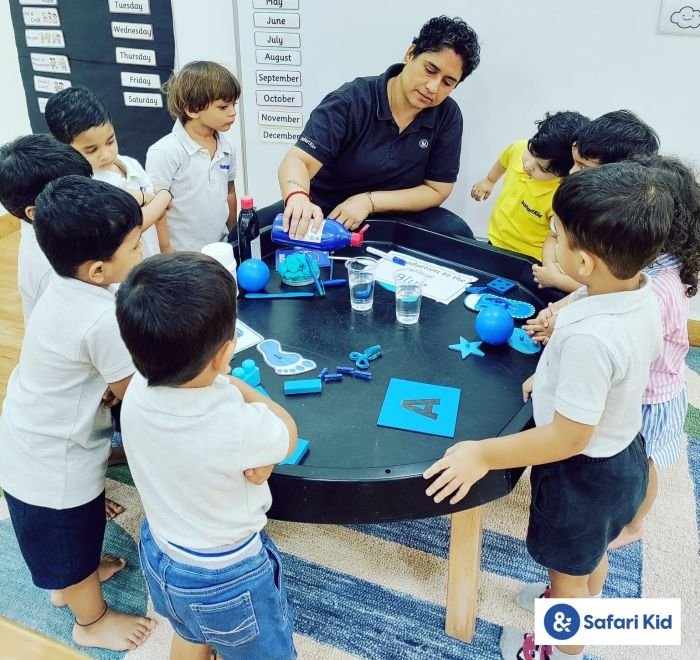
When children play, whether with blocks or during a game, they develop problem-solving and critical-thinking skills. Play helps improve hand-eye coordination and teaches patience and resilience. These early experiences prepare them for future learning. Through play, children develop essential cognitive, social, and physical skills that lay the foundation for future success. Whether it is splashing water, molding clay, or squishing soft toys, children are exploring through play; it’s their way of making connections with the world outside.
Nurturing Cognitive & Socio-emotional growth through play
If you observe a child closely, you will find cognitive and socio-emotional growth are like two sides of the same coin. Imagine a child building a block tower. As he balances blocks to build his tower, his brain is making predictions, testing hypotheses, and shaping stories. When the tower falls, he may experience a pang of frustration at first. Then, maybe he tries again, or laughs it off or both; his brain is masterminding resilience. Say, a friend helps him rebuild or cheers him on. That child’s brain is building cooperation and empathy when his friend claps for the block tower or comforts him when it falls over. These everyday moments are not the kind of “skills” you drill using flashcards or books. Nevertheless, they are what will help your child learn persistence, focus, problem-solving, as well as how to connect, share, and manage his emotions. This suggests that play supports children’s amazing ability to transform themselves into smart, kind, well-rounded people through play.
Designing a curriculum that blends culture & creativity
Behind the fun and games, thoughtful planning happens. A great early learning program balances structure and freedom. Stability and security come from routine, while open-ended activities spark creativity and self-expression. Incorporating local traditions, stories, and values helps children connect with their community and heritage, making learning more meaningful and personal. By celebrating local festivals, sharing folk tales, or singing native songs, children develop a strong sense of identity and belonging.
From Invisible to Impactful
There are different kinds of play, and each teaches children something different. There’s structured play such as puzzles or board games, which require children to follow rules, build patience, and learn strategy. There’s semi-structured play, such as building with blocks or art, which are guided activities with a lot of room for imagination. And then, there is free play, where children make up their own games, role-play, or run wild, setting their own rules.
Let’s take the classic “two kids, one toy” scenario. One grabs it, the other wants it, and then it breaks into a conflict. But after squabbling, negotiating, a few tears, and some trial and error, they come to a solution: take turns, play together, or grab another toy. All these tiny battles of give-and-take build empathy, collaboration, and problem-solving.
Therefore, preschools that include play in their curriculum are setting the stage apart. When they treat play as the foundation, not a break from learning, they’re shaping balanced, confident kids who are ready for both the classroom and the world outside it.