
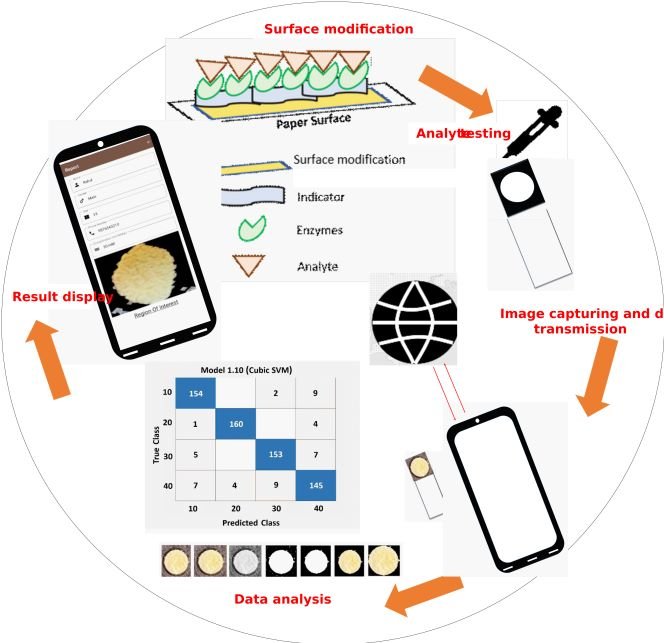
Indian Institute of Technology Jodhpur researchers have created a unique system, where smartphones can be used to test glucose levels in patients to provide quick, and easy-to-access testing results. The entire system connects a Paper-based analytical device to any smartphone using an Android app, which allows for the detection of the sample for glucose (with a concentration range of 10−40 mM).
Paper-based analytical devices (PADs) are portable devices that have revolutionised point-of-need testing and can quickly assess biochemical samples. The device comes with a lab based functionalized biodegradable paper that alters its hue based on the level and amount of glucose present. By connecting it to a smartphone, the researchers have made the entire process of tracking glucose levels even faster and more personalised.
This device is aimed to be developed for the personal use of the public. It can provide on-the-spot glucose testing results without requiring technical or sophisticated laboratory settings. Additionally, it is designed to be cost-effective and biodegradable, with the current cost of it at only ~ Rs. 10 in the lab. The team hopes to further make it even cheaper during mass production, at Rs. 5.
The research was performed by the Team including Prof. Ankur Gupta, Mr. Vinay Kishnani, Mr. Nikhil Kashyap, and Mr. Shivam Shashank from the Department of Mechanical Engineering, Indian Institute of Technology, Jodhpur.
Dr. Ankur Gupta, Associate Professor, Department of Mechanical Engineering, IIT Jodhpur and one of the authors of the study explains, “Smartphones offer seamless integration with other technologies and platforms. The ability to connect the smartphone-based spot detection framework to a larger network or database can facilitate remote monitoring, data storage, and sharing of results. This connectivity can be crucial for healthcare professionals or researchers.”
A major hindrance when it comes to PADs is that they need specific light conditions to work. However, this system developed by the researchers completely does away with that disadvantage and allows for the PAD to work, and transmit information to smartphones under nearly all possible light conditions.
By using artificial glucose samples, various images of the coloured samples were processed using a machine learning application, to develop the smartphone app. This ensured that the intensity of colour from the PAD was not influenced by the light condition and the type of camera in a smartphone. Thus, the PAD can be connected to any smartphone with varying camera optics. The research work was published in ACS Publications. (DOI: https://doi.org/10.1021/acsabm.3c00532).
Dr. Ankur Gupta elaborates that this research has far-reaching potential, saying “This study demonstrates that this developed system is equipped for initial disease screening at the user end. By incorporating machine learning techniques, the platform can provide reliable and accurate results, thus paving the way for estimating the accuracy of the results for improved initial healthcare screening and diagnosis of any disease.”
This module can be adaptable to detect other diseases by providing sample data for training and testing. For the futuristic application, the team is working on the simultaneous detection of glucose, uric acid, and lactate by utilizing different color indicators as different color codes in nonblood entities. As of now, even though this framework only works for glucose samples, this approach can be employed for the screening and diagnostic analysis of other diseases as well. While the basic concept remains the same, it needs adaptation for different target analytes, enzymes, and indicators. The captured images can then be further trained for machine learning analysis, to allow for diagnosis information to reach straight to the smartphone of the user.