
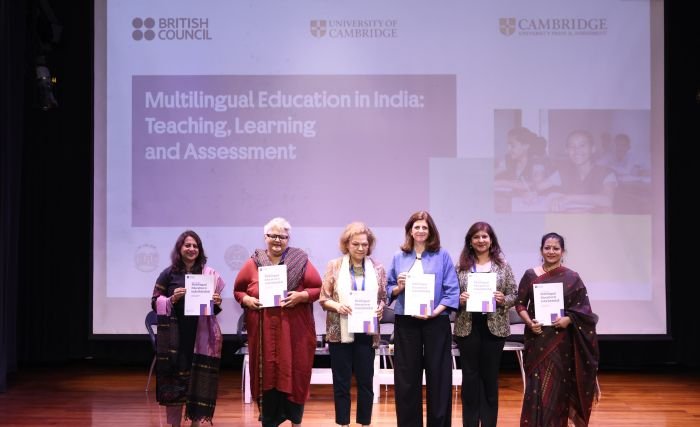
A report on Multilingual Education in India (MultiEd) has shown that structured multilingual pedagogy approach strengthens reading comprehension and improves learning outcomes in English-medium government schools in India. The report published by British Council, the UK’s international organisation for cultural relations and educational opportunities in collaboration with Cambridge University Press & Assessment and the University of Cambridge, was unveiled at the recently held South-South Learning Symposium, which was jointly convened by the British Council and the National Council of Educational Research and Training (NCERT), focused on mutual knowledge exchange around large-scale school education reforms.
The event had brought together senior education leaders from across the Global South, particularly African countries, and featured partners including Association for the Development of Education in Africa (ADEA), Foreign, Commonwealth & Development Office (FCDO), Bill & Melinda Gates Foundation, UNESCO, UNICEF, World Bank, University of Oxford, University of Cambridge and the What Works Hub for Global Education.
The findings are drawn from a three-year study (2023–2026) funded by the British Council and awarded to Cambridge University Press & Assessment and led by Professor Ianthi M. Tsimpli of the University of Cambridge’s Faculty of Modern and Medieval Languages and Linguistics.
Alison Barrett MBE, Country Director India, British Council, said: “Language lies at the heart of learning, and the vision of NEP 2020 recognises the importance of multilingualism in shaping inclusive and effective education systems. In a linguistically rich country like India, building on the languages children bring to the classroom is both equitable and pedagogically sound. The MultiEd findings reaffirm that English does not need to replace home languages to succeed; it can grow alongside them. Our research demonstrates that structured multilingual pedagogy strengthens reading comprehension and academic understanding without compromising English proficiency.”
Professor Ianthi M. Tsimpli, University of Cambridge added:
“In a country where multilingualism is a lived reality, education systems must reflect learners’ linguistic richness. English opens doors to opportunity while supporting the maintenance and development of native languages. The MultiEd report demonstrates that structured multilingual approaches can strengthen reading comprehension, improve wellbeing, and enhance learning outcomes in English-medium classrooms. By combining rigorous research with practical tools, this work offers valuable insights for bridging policy, research and classroom practice in India and beyond.”
The MultiEd intervention behind the research builds on the earlier MultiLila programme, taking forward its insights into a more structured and scalable model of multilingual pedagogy for English-medium classrooms. What sets the study apart is its strong evidence base, including a large teacher talk corpus capturing real classroom language practices, and bilingual assessments designed to measure learning across both English and home languages.
The intervention introduced practical, classroom-ready strategies such as structured multilingual lesson planning, purposeful read-aloud approaches including text chunking, and the planned use of home and regional languages alongside English. Supported by peer-learning activities and ongoing mentoring, these approaches enabled teachers to move from informal code-switching to intentional, goal-oriented pedagogical translanguaging.
A key outcome of the project is the development of a coherent MLE (Multilingual Education) pedagogy, alongside a suite of resources that bridge research and classroom practice. The findings show that when multilingual strategies are systematically embedded, they can strengthen reading comprehension and deepen learning, while maintaining progress in English.
The report recommends institutionalising pedagogical translanguaging within English-medium instruction and embedding multilingual approaches into teacher education systems, in alignment with NEP 2020. By combining rigorous evidence with practical tools, the MultiEd study offers a clear and scalable pathway for advancing multilingual education in India and across the Global South.